
The stuff I had Pia buy from the US finally arrived. Which is perfect since I was contemplating on recording some shit once again.
I think I’m beginning to become a Planet Waves whore. The sheer practicality of the stuff they make reminds me of those Japanese inventions for practical living. They don’t look so good, but the concepts are very useful for living. Planet Waves‘ stuff on the other hand do not suffer from that dilemma as their products both have function and form.

I already got the Auto-Trim Tuning Machines which are basically locking tuners/machine heads which not only lock the strings, but also nip the slack off while you turn the gear heads. This makes string changing very easy and neat. I always was worried about string slippage though, after all the concept of locking tuners simply clamp on the strings as hard as you can wind the locking mechanism. While it’s pretty much safe for the thicker strings, I always wondered about the thinnest ones. But my T5‘s been on them for quite a while, and I think that just proved that there’s nothing to worry about.

Another Planet Waves product I got was an instrument humidifying set – which was comprised of a humidifier and digital hygrometer (pictured). Which has proven to be extremely useful. When I got back home, it was pretty dry – the RH 1 Relative Humidity level being way below 40 2 The ideal (according to Taylor specs, which is the RH of their manufacturing environment) would be 47-50.. While guitars aren’t necessarily uber-sensitive to changes in humidity, it is to be noted that prolonged exposure to too low an RH level may result in the wood drying up and ultimately cracking as it warps from shrinkage. Conversely, prolonged exposure to too high an RH will bloat a body and can probably cause the same problem when it “over-inflates” from the water it’s storing.
Nowadays, I keep the humidifier out because no matter what I do, the RH is always above 57, which worries me because that reading was recorded with the hygrometer being inside the T5‘s case. An instrument inside a hardcase is pretty much the second best 3 The best being keeping the environment itself regulated. thing you can do to keep it’s internal environment from being affected by the outside environment. This suggests that the RH outside is much higher, that the humidity is seeping inside of the case. While irritating, I’m not panicking since an instrument is more resilient to over-humidifaction than under – hence I’m not considering putting silica gel in the case anytime soon.
In any case, I’m digressing from the actual point of the post. Back to being a Planet Waves whore.
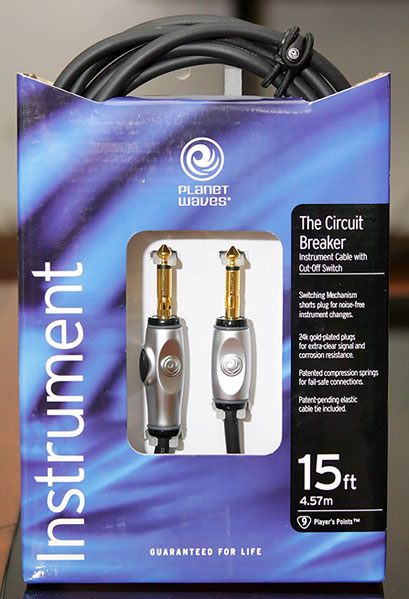
The Circuit Breaker
Another product I got is what they call their “Circuit Breaker” – which is another damned good idea. If you check the image’s Flickr page, I point out the different features in the image.
First, is that one end of the cable has a switch – which breaks the circuit (duh). You see, guitars with active pickup systems (especiallly acoustic-electrics) need power to work, hence the battery requirement. To conserve power, what manufacturers do is to have the point of contact to an instrument cable as a severed circuit – wherein the metal contact of your cable completes the circuit and enables the system every time you jack-in.
While this isn’t a big deal on a live environment where you usually need the instrument to be plugged in the whole time anyway, this architecture can be very irritating when you have intermittent breaks in whatever you do. Perhaps when you use it in worship during the mass. Or like me, when recording alone at home. It’s really a pain in the ass to have to disconnect the cable [to save batteries] every single time you’re going to do something else… knowing you’re going to pick the guitar up again. This switch solves that issue, as well as making it possible to actually connect/disconnect silently to your amplifiers – very useful in live situations where you don’t have to kill the volume on the amps/PA when jacking in/out.
Second, aside from the gold contacts, 4 Having gold-plated contacts seems to be standard with high quality audio equipment. there’s a little part down the contacts themselves have strips that bulge out. They call them compression springs – which are supposed to, since they push outward, make extra sure your jack connects with whatever it is you’re plugging into.
Last are the little things, such as interchangeable color rings for color-coordination. And that the cable comes with it’s own sexy cable-tie. The picture doesn’t do it justice, but trust me it’s a really cool cable tie. There’s also a lifetime guarantee, which I really don’t know how I’m going to avail of from this country, but still, it’s nice to know their dedication in quality.
Lastly is upon researching this cable, it employs a solderless construction – which precisely means there’s no soldering involved, but what does this entail? It means that the way the contacts connect to the actual cable are similar to crimping.5 Which entails clamping tightly onto something. The difference is that while crimping is a one-time deal, Planet Waves‘ solderless connection can be re-used anytime, with any cable, without soldering required. Very useful should you be unfortunate enough to wreck your cables (or if your dog chews on them).
Other Stuff

Now that the Planet Waves stuff have been dealt with, I also got two other things for my guitar. First would be a Wedgie headstock-mount pick holder which is self-explanatory from the picture. And lastly is this (which also is self-explanatory):

D’Addario 25-set string bulk pack.
They come out really cheap by the bulk, plus it’s easier for me considering how often my strings rust. I used to think the reason why the strings rusted so easily was because the oils in my hands which can corrode the strings (which is pretty normal) were extra-strength, but given the information from my hygrometer, I’m re-thinking that theory. The T5 actually still comes with the strings that shipped with it. It uses Exilir nano-web strings, which work as advertised 6 Anti-rust, anti-corrosion, and are awesome – but it will just be a matter of time before they too kick the bucket. Unfortunately, while I would prefer the Exilir brand, they’re damned expensive – and D’Addario, aside from the lifespan issue, have proven to be the best value for the money.
Notes
| ⇡1 | Relative Humidity |
|---|---|
| ⇡2 | The ideal (according to Taylor specs, which is the RH of their manufacturing environment) would be 47-50. |
| ⇡3 | The best being keeping the environment itself regulated. |
| ⇡4 | Having gold-plated contacts seems to be standard with high quality audio equipment. |
| ⇡5 | Which entails clamping tightly onto something. |
| ⇡6 | Anti-rust, anti-corrosion |